Miami real estate market snapshot: luxury markets and investment trends
Miami is no longer just a city for holidays and beach houses. Over the last few years, it has become a destination for many buyers, including those from Dubai. The city offers something familiar yet distinct. Strong demand, steady development, and a clear structure behind every deal make it easier to assess. Buyers look beyond beaches now. Numbers, location choices, and timing all carry weight in purchase decisions. This shift explains why Miami attracts serious buyers, who value stability and long-term planning over quick moves.
Key Takeaways
- Single-family homes average $640,000–$650,000, while condos sit around $420,000
- Cash buyers dominate the luxury segment, especially above the $1 million mark
- Brickell, Downtown, Edgewater, Wynwood, and Coral Gables are core areas for buyers with different investment goals
- Foreign buyers enjoy the same ownership rights as locals, with no residency requirement
- Branded residences and office-to-residential conversions are shaping new supply
- Luxury entry prices start around $500,000 in central areas, with ultra-luxury concentrated in Coconut Grove and Bay Harbour Islands
Miami Real Estate Market Overview 2026
Miami’s real estate market in 2026 feels calmer and more organised than before. Inventory has increased across Miami-Dade County, which gives buyers more time to compare options. Homes now take approximately 90 to 105 days to sell. Pricing has settled after several years of sharp growth. Single-family homes in Miami-Dade trade for approximately $640,000 to $650,000 (AED 2.35 million to AED 2.39 million). Condo prices average approximately $420,000 (AED 1.54 million), supporting demand from buyers seeking central locations on limited budgets. These numbers give both buyers and sellers a shared point of reference before negotiations begin.
The current Miami real estate market gives buyers:
- More choice across property types
- Extra time to assess locations and pricing
- Stronger position during negotiations
Buyer activity is healthy, particularly at the higher end of the market. Cash buyers account for more than 40% of total transactions, with an even higher share above the $1 million (AED 3.67 million) range. Mortgage rates range from 5.6% to 6.4%, yet demand remains strong, driven by solid equity positions and long-term investment planning.
Luxury real estate is performing well, supported by limited supply and international demand. Homes priced above $1 million attract buyers focused on waterfront access, privacy, and full-service living. New branded developments continue to gain traction, particularly those that offer high build quality and long-term appeal.
What are the Most Popular Regions in Miami?
Brickell
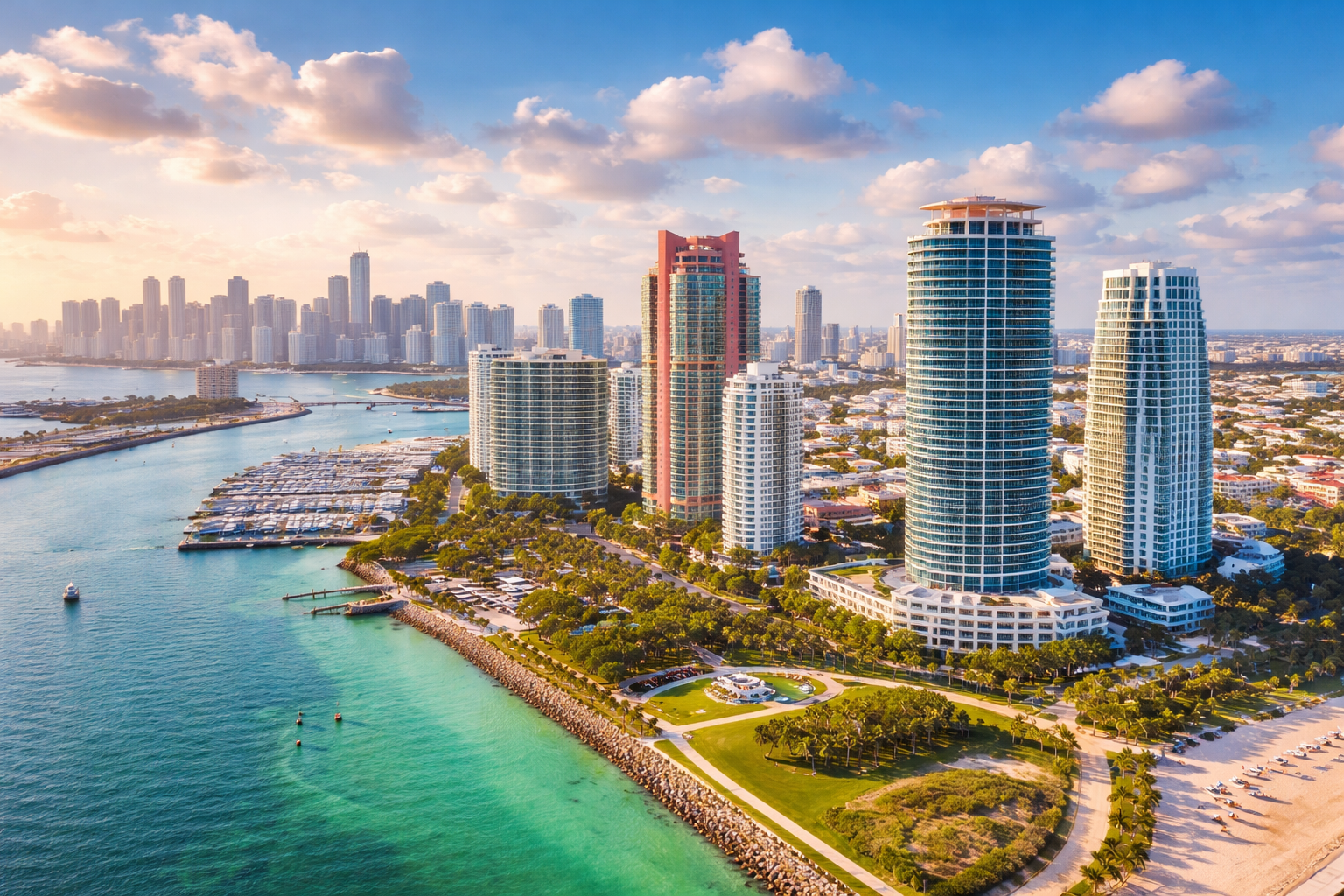
If you love being in the centre of the action, Brickell is your spot. It's Miami’s financial hub, defined by modern skyscrapers, luxury hotels, and established dining destinations such as Brickell City Centre. The area is busy and fast-moving, with walkable streets that attract young professionals and international residents.
Average Condo Price: Approximately $750,000 (AED 2.75 million), with a price per square foot of $762 (AED 2,800). Luxury and branded towers can easily reach the multi-million-dollar range.
Rental Market: Strong year-round demand. You’ll find studios starting around $2,500/month (AED 9,200/month), while luxury units can average over $5,700/month (AED 20,900/month).
Downtown Miami
Downtown is where Miami’s history and future meet. It’s home to major cultural landmarks like the Pérez Art Museum Miami (PAMM) and the Kaseya Centre. With massive transit connections like the Metromover, it’s arguably the most connected part of the city.
Average Condo Price: Between $605 (AED 2,220) and $1,146 (AED 4,205) per square foot, depending on the building's age and luxury features.
Rental Market: Extremely consistent demand. Average rents are roughly $3,280/month (AED 12,040/month), with a wide range from $1,725/month (AED 6,330/month) for studios to over $7,600/month (AED 27,900/month) for high-end two-bedroom units.
Edgewater
Just north of Downtown, Edgewater offers a more laid-back, residential vibe while keeping you close to everything. It’s famous for its amazing views over Biscayne Bay and easy access to the 8-acre Margaret Pace Park. It’s a favourite for those who want a quieter urban lifestyle with plenty of outdoor space.
Average Condo Price: Generally more competitive than Brickell, with medians around $700,000 (AED 2.57 million) and an average of $640 (AED 2,350) per square foot.
Rental Market: Highly active with newer waterfront towers. Rentals start at $2,100/month (AED 7,710/month), with larger luxury units averaging closer to $6,500/month (AED 23,900/month).
Wynwood
Wynwood has transformed from an industrial district into a global destination for street art, breweries, and tech startups. Large-scale murals line the streets and contribute to one of Miami’s most walkable neighbourhoods. With fewer high-rise towers, the area focuses on loft-style residences and attracts investors drawn to short-term rental demand and creative-driven communities.
Average Condo Price: Between $722 (AED 2,650) and $1,021 (AED 3,750) per square foot.
Rental Market: One of the most sought-after locations for younger crowds. Average rents are around $3,425/month (AED 12,565/month), with studios and one-bedrooms ranging from $1,985/month (AED 7,285/month) to $3,470/month (AED 12,735/month).
Property Ownership Process for Locals and Foreigners

Buying property in Miami is more open than in many other global cities. Local residents and foreign buyers are subject to the same ownership rules. No residency or citizenship requirement applies when purchasing real estate in Florida. Foreign nationals hold full ownership rights, which makes the market easier to access for international investors.
How the Buying Process Works
Buying property in Miami follows a step-by-step process, and each stage has a purpose.
Working with a real estate agent
The first step is to hire a local real estate agent who understands the area and its pricing trends. Buyers coming from overseas choose agents familiar with international transactions, paperwork, and timelines.
Sorting out finances early
Buyers who pay in cash provide proof of funds before proceeding. Buyers using a mortgage arrange pre-approval at this stage. Foreign buyers make higher down payments, between 30 and 50%. The exact percentage varies by lender and property type:
Single-family homes/standard condos: 25% to 35%.
Condos/townhouses (under $750k loan): Around 30% to 35%.
Loans over $1 million: The down payment can be as high as 40% or more.
Investment properties: Require a higher down payment of 40% to 50%.
Finding a property and making an offer
Once a suitable property is selected, a written offer is submitted. After acceptance, both parties sign a purchase agreement, commonly an AS-IS contract in Florida. An earnest money deposit, usually 1 to 3% of the purchase price, is placed into an escrow account.
Inspections and checks
A due diligence period follows, allowing buyers to conduct a proper inspection of the property. General inspections, pest checks, and flood zone reviews are typically conducted here. A title search also confirms legal ownership and checks for any outstanding claims on the property.
Closing the transaction
Closing happens once all conditions are met. Buyers sign final documents, including the deed and loan paperwork when applicable. Remaining funds and closing costs are paid, and the title company records the new ownership with the county.
Setting up utilities
After closing, utilities such as electricity and water are transferred into the new owner’s name. This final step completes the process and allows the buyer to take full possession of the property.
Once these steps are complete, ownership becomes official, and buyers can confidently use or rent the property.
Key Differences for Foreigners
In general, foreign nationals can purchase property with the same ownership rights as U.S. citizens. However, Florida’s Senate Bill 264 places restrictions on buyers from countries designated as “countries of concern,” including China, Russia, Iran, North Korea, Cuba, Venezuela, and Syria. Under this rule, individuals from those countries cannot purchase agricultural land or property within 10 miles of military bases or critical infrastructure.
Developments and Market Trends Shaping Miami
Miami’s property market changes in ways that feel practical and easy to notice. Some changes stand out more than others, especially for buyers who follow global real estate closely.
Branded residences are gaining attention across the city. Well-known hotel groups and fashion labels now lend their names to residential towers. Buyers familiar with branded residences in Dubai already understand the appeal. These homes focus on managed living, strong design standards, and long-term ownership value, which explains their steady interest.
Developers are reworking older office buildings in Downtown areas and turning them into housing. Older commercial spaces are now converted into rental apartments or mixed-use buildings. This approach adds new homes without spreading the city outward. Central locations remain active, and buyers gain more options near work and lifestyle hubs.
Infrastructure upgrades are shaping demand across key districts. Transport improvements, waterfront upgrades, and better public spaces make daily life easier. These changes support long-term value in areas close to the city core.
Rules around short-term rentals have also changed in some neighbourhoods. Stricter controls reduced speculative activity and prompted investors to shift toward long-term rental plans. Many buyers now prioritise steady income over quick returns, leading to greater overall market consistency.
What is the Luxury Market and Prices like in Miami?
Miami’s luxury market covers a wide price range, and location plays a big role in how far a budget can go.
In Downtown Miami, luxury pricing starts at around $500,000 (AED 1.84 million). Studio residences in projects such as 14 River District start at approximately $550,000 (AED 2.02 million). Developments such as Gale Miami Hotel & Residences range from approximately $516,000 (AED 1.89 million) to $1.6 million (AED 5.87 million). These homes come fully furnished and ready to use, which suits investors and buyers looking for second homes.
Midtown sits slightly higher on the pricing scale. Projects like The Rider Residences start near $648,900 (AED 2.38 million). These units are also delivered fully furnished.
Brickell attracts strong demand due to its central location and rental activity. Domus Brickell Centre starts at approximately $500,000 (AED 1.84 million), while Domus Brickell Park starts at approximately $620,000 (AED 2.28 million). Both are approved for short-term rentals. At the upper end, Lofty Brickell starts at around $2.4 million (AED 8.81 million). Ultra-luxury towers such as 1428 Brickell start at approximately $3.9 million (AED 14.31 million) and are aimed at buyers seeking privacy, views, and full-service living.
Miami Beach offers renewed options across different price points. 72 Park Miami Beach starts around $800,000 (AED 2.94 million), while PMA Miami Beach Residences range from $600,000 (AED 2.20 million) to $1.7 million (AED 6.24 million). These developments focus on furnished, turnkey homes near the beach.
Bay Harbour Islands caters exclusively to buyers in the ultra-luxury segment. Projects like Origin Residences by Artefacto start at around $3.8 million (AED 13.95 million), reflecting limited supply and a private residential setting.
Coral Gables provides a more boutique luxury feel. Cassian Residences start at approximately $824,000 (AED 3.02 million), Avenue Coral Gables at approximately $848,000 (AED 3.11 million), and 17 Gables at approximately $634,900 (AED 2.33 million). These developments appeal to buyers who prefer quieter surroundings with strong long-term value.
At the very top end, Coconut Grove leads with projects such as Vita at Grove Isle, where prices start at approximately $6.5 million (AED 23.86 million). These homes focus on exclusivity, waterfront access, and limited inventory.
Quick price overview by area
Buyers with budgets between $500,000 and $1 million can access luxury properties across Downtown, Midtown, Brickell, Coral Gables, and Miami Beach. New developments in this range offer studios to three-bedroom layouts, modern finishes, and ready-to-use interiors. Entry into Miami’s luxury market is more approachable than many expect.
Final Thoughts
Miami’s real estate market is easier to judge with its clearer pricing and better structure. Prices move at a sensible pace, so buyers need to plan decisions without rushing timelines. International interest is strong here, supported by ownership rules that apply equally to local and overseas buyers. Luxury homes are within reach in many cities worldwide at comparable price points. Buyers focus on long-term plans and prioritise location quality and rental demand. This keeps Miami relevant for buyers seeking stability, structure, and future value.
Planning a property move in Miami starts with the right people around you. A real estate team with on-the-ground knowledge can guide you through pricing, location, and ownership steps with clarity. Advice based on real data and local experience makes decisions easier.
Speak with our real estate team to discuss Miami property options, pricing, and the buying process, with guidance tailored for international buyers at every stage.
Frequently Asked Questions
Can foreign buyers purchase property in Miami without residency?
+−
Yes, foreign buyers can purchase property in Miami without holding US residency or citizenship. Ownership rights are the same as for local buyers, which makes the process accessible for international investors.
Which areas in Miami are popular for property investment?
+−
Brickell, Downtown Miami, Edgewater, Midtown, Wynwood, Coral Gables, and Miami Beach attract strong buyer interest. Each area suits different goals, from rental-focused condos to long-term residential holdings.
What is the average price of luxury property in Miami?
+−
Luxury properties in Miami typically start at around $500,000 in central areas such as Downtown and Brickell. Prices rise significantly for waterfront homes and exclusive neighbourhoods such as Coconut Grove and Bay Harbour Islands.
How long does it take to buy property in Miami?
+−
Most property transactions in Miami are completed within 30 to 45 days once an offer is accepted. Cash purchases may close faster depending on inspections and documentation.
Do foreign buyers pay more taxes when selling property in Miami?
+−
Foreign sellers are subject to FIRPTA, which requires a 15% withholding on the gross sale price.