
How to price your property correctly in Dubai?
Putting a price on your home goes beyond counting rooms or measuring floor space. It reflects the life built there, the location you chose, and the moment you decide to sell. In this fast-moving city, pricing also depends on how well the market is understood and how property valuation in Dubai really works. What goes into pricing a property is not always obvious.
Key Takeaways
- Pricing a property in Dubai depends on how buyers compare homes and respond to real market data.
- Recent sale prices give a clearer picture of what buyers are actually willing to pay.
- Overpricing can reduce viewings and slow momentum, while underpricing can leave value on the table.
- Researching similar homes, understanding buyer behaviour, and staying objective all play a role in setting the right price.
- Limited interest in the first few weeks is usually a pricing signal, not a timing issue.
Why Does Property Pricing Matter in Dubai?
You might think it’s better to price your home high; after all, buyers will negotiate, right? Sure, some will. But most won’t even show up if the price feels too far off. In today’s Dubai market, buyers are doing their homework. They have got listings bookmarked, agents on WhatsApp, and data at their fingertips. If your price does not align with the market value that Dubai property buyers expect, interest can fade quickly.
Here’s what happens:
- If you overprice your home, you get fewer viewings. It sits on the market longer, and eventually, you drop the price.
- If you underprice it, you risk leaving money on the table, especially in high-demand areas like Jumeirah Village Circle (JVC) or Downtown Dubai.
Dubai’s property market moves fast. It reacts to changes in visa requirements, interest rates, new developments, and even global politics.
To give you a rough idea, the average price per square foot in Dubai is:
Apartments: AED 1,300 - 1,800/sq. ft.
Villas: AED 2,000 - 2,500/sq. ft.
Townhouse: AED 1,200 - 1,500/sq. ft.
Affordable communities (e.g., International City): AED 500-800/sq. ft.
These figures give a starting reference, but property price estimation in Dubai depends more on recent sales than published averages.
How Do You Price a Property Correctly?
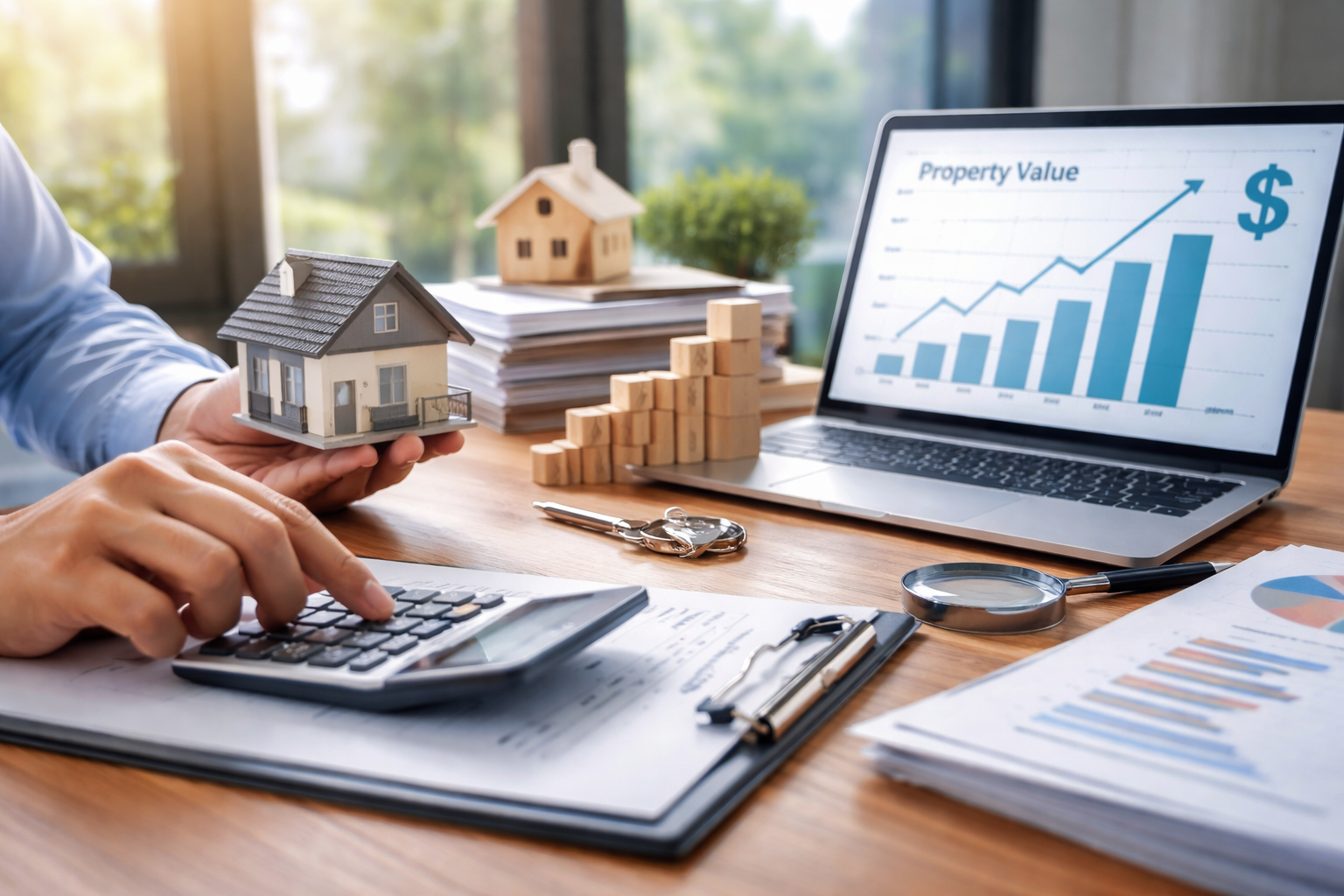
Pricing a property is rarely about instinct alone. Buyers compare options quickly, notice small differences, and move on just as fast. The homes that get attention early are usually priced with a clear view of the market, not assumptions. Understanding how prices are shaped is the first step before putting any number on paper.
The section ahead explains how to arrive at the right price.
Do Your Research
This is a key part of how to price property in Dubai without relying on guesswork. Before you list your property, open a few Dubai property portals. Search for homes similar to yours in your neighbourhood with the same number of bedrooms, roughly the same size and the same building if it's an apartment.
Pay attention to a few simple details:
- Asking prices compared to similar homes
- How long have those listings been live
- Any recent price drops
Suppose you own a 2 bedroom apartment for sale in Downtown Dubai. You see three similar units listed between AED 5,100,000 and AED 5,650,000. One of them has been on the market for ninety days. That is usually a warning sign, as it may be priced too high.
If the sold data is available, review that next. Some agents can help access it. Sold listings show what buyers are actually paying, not what sellers are hoping for.
Work With An Agent

Some sellers choose to sell on their own to avoid paying commissions. That choice can limit exposure and negotiation strength. A good agent does more than upload a listing. They bring qualified buyers, negotiate offers, and manage paperwork from start to finish.
When choosing an agent, look for:
- Strong knowledge of your specific area
- Recent closed sales, not just active listings
- Advice that sounds realistic
A useful question to ask is, “What do you think is a realistic price for my home, and why?” If the answer feels vague or simply echoes what you want to hear, it may be worth reconsidering.
Some sellers also check their price using the betterhomes property valuation service. It analyses recent sales and nearby comparable homes to estimate a property's likely value. When used with an agent’s advice, it helps sellers choose a price based on what’s actually happening in the market.
This kind of guidance is often what turns a rough estimate into a more accurate property price estimation in Dubai.
How Do Emotions Affect Property Pricing Decisions?
This part can be hard for many sellers. You might have lived in your home for 10 years, raised a family there, and spent money on upgrades like imported tiles and custom wardrobes. To you, it feels priceless, but to a buyer, it’s just a 3-bedroom home in Meadows with a nice layout. That’s why it’s important to separate your emotions from the actual market value. Try to see your home the way a buyer would. Ask yourself, “If I didn’t own this place, would I pay this much for it?” That one simple question can help you look at things more clearly.
Don’t Copy Asking Prices
The price you see online isn’t always the price a home sells for. Many sellers start high, hoping to get lucky, but real sale prices are usually lower. Agents can check Dubai Land Department data to see what homes are selling for. Reaching the best price to sell property in Dubai comes from pricing close to actual sale prices, not from hopeful listings. For example, a 2-bedroom apartment in Jumeirah Golf Estates might be listed at AED 2,700,000, but recent sales show most are selling for around AED 2,200,000 to 2,300,000. That’s a big difference. Ask your agent for a CMA (Comparative Market Analysis) with recent sales in your area.
Some sellers ask if they can add AED 100,000 for negotiation. A small buffer can work when used carefully. If your target is AED 2,500,000, listing at AED 2,600,000 is reasonable. Listing at AED 2,900,000 in hopes of bargaining down can backfire.
Most buyers use price filters when searching online. A buyer looking up to AED 2,600,000 will never see a listing priced at AED 2,900,000, even if the seller is open to a lower offer. Staying within a realistic range keeps serious buyers in view.
Learn From Other Listings
If you find a similar home that’s been listed for a long time without selling, it’s worth taking a closer look. There’s probably a reason it hasn’t sold, and you can learn from it.
Inspect the Photos
Are they dark, blurry, or taken at odd angles? Poor photos can turn buyers off right away, even if the home is great. Make sure your listing has clear, high-quality images that show your home in the best light.
Look at the layout.
If the other home has a strange or less practical floor plan and yours is similar, that could be a red flag. Buyers might hesitate for the same reason, so you may need to adjust your price a little to reflect that.
When Should You Adjust the Price of a Property in Dubai?
Suppose you put your home on the market, and two weeks passed. Only a few people came to see it, but no one made an offer. That’s a sign that the market is telling you something. If there’s still no serious interest after 30 days, it may be time to lower your price a little. The first month is the most important time to attract buyers. If your price is too high, you could miss out on good offers. So don’t waste that early window by holding out for more than the market is willing to pay.
Conclusion
Selling a home in Dubai does not have to feel complicated, but pricing it well does require clarity. Pricing is one of the first and most important steps when learning how to sell your property in Dubai. Homes priced too high tend to lose momentum early, while realistic pricing keeps buyers engaged from the start. Looking at recent sales, understanding buyer behaviour, and separating emotion from numbers all play a part. Location, condition, layout, and timing matter more than guesswork. When pricing reflects what buyers are paying today, property valuation in Dubai becomes clearer and easier to manage.
If you want a clearer view of what your home is worth today, betterhomes professional property valuation service can give you a realistic starting point before making any pricing decisions.
Frequently Asked Questions
Is it a good time to sell property in Dubai?
+−
The best time to sell property in Dubai is usually during the cooler months, from October to April, when many tourists and expats are in the city. This time of year attracts more buyers, which can increase demand and help you get a better price.
Is it easy to sell houses in Dubai?
+−
Selling a house in Dubai can be tricky, but it’s possible if you do it the right way. The property market in Dubai is busy, but things like when you sell, the condition of your home, and how you market it can all affect how quickly and successfully you make a sale.
How much are property valuation fees in Dubai?
+−
In Dubai, getting a property valuation costs between AED 2,500 and AED 3,500. The price can vary depending on the type of property and its complexity.
Can you negotiate property prices in Dubai?
+−
Yes, property prices in Dubai can be negotiated, especially for pre-owned (secondary market) homes.
What is the best way to sell my property?
+−
The best way to sell a property in Dubai is to work with a good real estate agent, ensure your home is well-prepared, and use strong marketing to attract buyers.
Is it better to overprice a property and negotiate later?
+−
Overpricing can reduce visibility and limit enquiries. Many buyers use price filters, so a property listed too high may not even appear in their search results, even if the seller is open to negotiation.
What is the market value of a property in Dubai?
+−
The market value of a Dubai property is the price buyers are currently willing to pay based on recent sales of similar homes. It can differ from asking prices and change with market conditions.